



Every business wants employees focused on meaningful work, not administrative tasks. Yet many organizations still rely on spreadsheets, paper receipts, and email chains to manage expenses. While manual expense reporting may seem manageable, it often leads to wasted time, delayed approvals, compliance risks, and reduced productivity.
The hidden cost isn’t just financial. It’s the countless hours employees and finance teams spend processing expenses instead of contributing to business growth.
Let’s explore how manual expense reporting impacts productivity and how a modern corporate expense management tool can solve these challenges.
What Is Manual Expense Reporting?
Manual expense reporting involves collecting receipts, filling out forms, sending approval requests, and manually reconciling expenses.
A typical process includes:
- Saving paper receipts
- Completing spreadsheets or forms
- Emailing managers for approval
- Finance teams verifying claims
- Manual reimbursement processing
As organizations grow, this process becomes increasingly difficult to manage efficiently.
The Productivity Problem
Employees Spend Too Much Time Reporting Expenses
Expense reporting is rarely part of an employee’s core responsibilities. Yet many employees spend hours every month:
- Collecting receipts
- Creating expense reports
- Following up on approvals
- Correcting submission errors
These small tasks quickly add up, reducing the time available for higher-value work.
Approval Delays Create Bottlenecks
Manual approvals often get stuck in inboxes or delayed due to travel, meetings, or workload.
This results in:
- Slower reimbursements
- Employee frustration
- Delayed financial processing
- Reduced operational efficiency
Without automation, even simple approvals can take days or weeks.
The Burden on Finance Teams
Finance departments often bear the largest impact of manual expense processes.
Excessive Administrative Work
Finance teams spend significant time:
- Reviewing expense reports
- Verifying receipts
- Checking policy compliance
- Reconciling transactions
Instead of focusing on financial planning and analysis, they are occupied with repetitive administrative tasks.
Increased Risk of Errors
Manual processes increase the chances of:
- Duplicate claims
- Missing receipts
- Incorrect reimbursements
- Data entry mistakes
Even minor errors can create larger issues during audits and month-end closing.
Limited Visibility Into Business Spending
One major challenge with manual expense reporting is the lack of real-time visibility.
Finance leaders often struggle to answer questions such as:
- Where is company money being spent?
- Which departments are exceeding budgets?
- Are employees following company policies?
- What spending trends are emerging?
Without centralized data, businesses are forced to make decisions based on incomplete information.
Compliance Risks
Expense policies are easier to create than enforce.
Manual processes often lead to:
- Policy violations
- Missing documentation
- Unapproved expenses
- Audit challenges
A lack of consistent oversight increases compliance risks and makes financial controls harder to maintain.
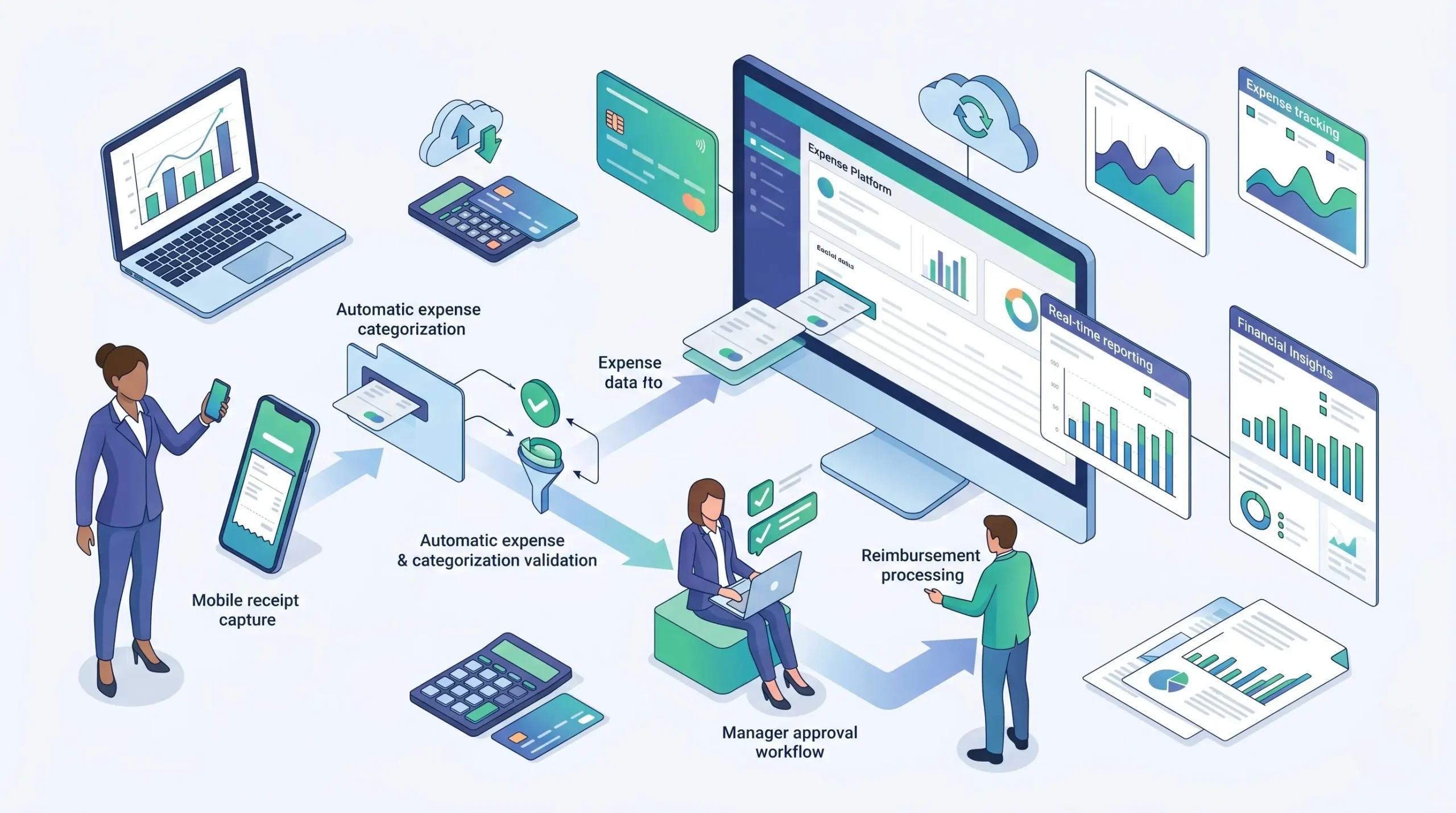
How Employee Expense Tracking Software Solves These Challenges
Modern employee expense tracking software automates the entire expense management process.
Faster Expense Submission
Employees can:
- Capture receipts instantly
- Submit expenses through mobile devices
- Track reimbursement status in real time
This reduces administrative effort and improves employee experience.
Automated Approval Workflows
Approvals are routed automatically to the right stakeholders.
Benefits include:
- Faster approvals
- Reduced bottlenecks
- Better accountability
- Improved workflow efficiency
Real-Time Expense Visibility
Finance teams gain access to:
- Live spending data
- Department-wise reporting
- Budget tracking
- Expense analytics
This helps organizations make smarter financial decisions.
Improved Compliance
Built-in policy controls can automatically flag non-compliant expenses before approval, reducing risks and improving governance.
Benefits of a Corporate Expense Management Tool
Organizations adopting a corporate expense management tool often experience significant improvements.
Increased Productivity
Automation reduces manual work for both employees and finance teams.
Faster Reimbursements
Streamlined workflows ensure employees receive reimbursements more quickly.
Better Financial Control
Real-time reporting provides complete visibility into company spending.
Reduced Errors
Automated data capture minimizes mistakes caused by manual entry.
Stronger Compliance
Policy enforcement becomes automatic and consistent across the organization.
Signs Your Business Has Outgrown Manual Expense Reporting
You may need expense automation if:
- Expense approvals take too long
- Employees frequently lose receipts
- Finance teams spend excessive time on reconciliation
- Budget visibility is limited
- Compliance issues occur regularly
- Audit preparation is difficult
If these challenges sound familiar, it’s time to consider a modern solution.
What to Look for in Expense Management Software
When evaluating expense management solutions, prioritize:
- Mobile expense capture
- Automated approval workflows
- Policy compliance controls
- Real-time reporting
- Accounting system integrations
- Advanced analytics and dashboards
The right solution should simplify expense management for employees while giving finance teams greater visibility and control.
Frequently Asked Questions
What is employee expense tracking software?
Employee expense tracking software helps businesses automate expense submission, approvals, tracking, and reimbursement processes while providing real-time spending visibility.
How does a corporate expense management tool improve productivity?
It reduces manual tasks, accelerates approvals, minimizes errors, and gives finance teams instant access to expense data.
Why is manual expense reporting inefficient?
Manual processes require repetitive data entry, slow approvals, and create visibility and compliance challenges.
Can expense management software help with audits?
Yes. It centralizes documentation, maintains expense records, and simplifies audit preparation.
What are the biggest benefits of expense automation?
Faster reimbursements, improved compliance, reduced administrative workload, and better financial visibility.
Conclusion
Manual expense reporting does more than slow down finance teams. It impacts productivity across the entire organization through wasted time, approval delays, compliance risks, and limited financial visibility.
By implementing a modern corporate expense management tool and employee expense tracking software, businesses can streamline operations, improve compliance, gain real-time insights, and empower employees with a faster, simpler expense management experience.
Ready to eliminate manual expense reporting?
Book a demo with ExpenseOut today and discover how automated expense management can help your business save time, improve control, and boost productivity.