the link between expense delays and employee dissatisfaction

The Link Between Expense Delays and Employee Dissatisfaction

Introduction

Imagine paying for a business trip with your own money, submitting an expense claim, and then waiting weeks for reimbursement. During that time, you’re following up with finance, searching for missing receipts, and wondering when the payment will finally arrive. Unfortunately, this isn’t an uncommon experience for many employees.

While delayed expense reimbursements may seem like a minor operational issue, they can have a significant impact on employee satisfaction, productivity, and trust. Employees who regularly face reimbursement delays often feel undervalued, especially when they’re covering business expenses out of their own pockets.

This is why organizations are investing in modern travel and expense management solutions and adopting an intelligent expense reporting platform. These technologies streamline the reimbursement process, improve transparency, and create a better experience for both employees and finance teams.

In this article, we’ll explore how expense delays affect employee morale, the business costs of inefficient reimbursement processes, and practical ways organizations can eliminate delays through automation.

Why Timely Expense Reimbursement Matters

Expense reimbursement isn’t just a finance function. It’s an important part of the overall employee experience.

Employees often pay for business-related expenses such as:

  • Flight tickets
  • Hotel stays
  • Local transportation
  • Client meals
  • Office supplies
  • Conference registrations

When reimbursements are processed quickly, employees feel supported and confident that the organization values their contributions. However, repeated delays can create frustration and reduce trust in internal processes.

Timely reimbursements also improve financial well-being, especially for employees who frequently travel for work or manage large client-facing responsibilities.

How Expense Delays Affect Employee Satisfaction

Delayed reimbursements have consequences that extend far beyond finance. They influence how employees perceive the organization and their day-to-day work experience.

Financial Stress

Not every employee has the flexibility to cover business expenses for extended periods.

Waiting several weeks for reimbursement can strain personal finances, particularly when travel costs include flights, hotels, or client entertainment.

Over time, this financial pressure can negatively affect motivation and engagement.

Reduced Trust in the Organization

Employees expect companies to honor legitimate business expenses promptly.

When claims remain pending without updates, employees may feel that their concerns are not a priority. Lack of communication often creates more frustration than the delay itself.

A transparent reimbursement process helps build confidence between employees and finance teams.

Lower Productivity

Employees should focus on their work, not on following up about expense claims.

Manual reimbursement processes often require employees to:

  • Send multiple reminder emails
  • Contact finance teams for updates
  • Search for missing receipts
  • Correct claim errors
  • Resubmit documentation

These unnecessary tasks reduce productivity and consume valuable working hours.

Declining Employee Engagement

Small operational issues can significantly influence workplace satisfaction.

Repeated reimbursement delays create negative experiences that affect employee morale, particularly for sales teams, consultants, and frequent business travelers.

Organizations with efficient reimbursement systems often report stronger employee satisfaction and better retention.

Why Expense Delays Happen

Many reimbursement challenges originate from outdated processes rather than employee mistakes.

Manual Expense Reporting

Paper forms, spreadsheets, and email approvals create unnecessary delays.

Finance teams spend considerable time reviewing claims manually, increasing processing time and the likelihood of errors.

Slow Approval Workflows

Expense reports frequently pass through multiple approval levels.

If even one approver is unavailable, the entire reimbursement process comes to a standstill.

Without automated reminders or escalation workflows, approvals can remain pending for days or weeks.

Missing or Incorrect Documentation

Employees sometimes forget receipts or enter incorrect information.

Finance teams must request additional documentation before processing payments, extending reimbursement timelines.

Limited Visibility

One of the biggest frustrations for employees is not knowing the status of their claims.

Without a centralized tracking system, employees often contact finance teams simply to ask whether their reimbursement has been approved.

The Business Impact of Delayed Expense Reimbursements

Expense delays don’t just affect employees. They also create measurable business challenges.

Increased Administrative Work

Finance teams spend significant time answering reimbursement queries instead of focusing on strategic financial planning.

Automated processes reduce repetitive administrative tasks and improve overall efficiency.

Higher Risk of Errors

Manual processes increase the likelihood of:

  • Duplicate claims
  • Data entry mistakes
  • Missing receipts
  • Incorrect reimbursements
  • Compliance issues

These errors can become costly during audits or financial reporting.

Employee Retention Challenges

Although reimbursement delays alone may not cause employees to leave, they contribute to a poor workplace experience.

Combined with other operational frustrations, slow reimbursements can reduce employee loyalty over time.

Poor Financial Visibility

Delayed expense processing also affects management.

If expense reports are submitted weeks after spending occurs, finance teams lose real-time visibility into organizational costs, making budgeting and forecasting less accurate.

How Travel and Expense Management Solves These Challenges

Modern travel and expense management software automates the entire expense lifecycle, reducing delays while improving accuracy.

Faster Expense Submission

Employees can submit claims immediately using mobile devices.

Instead of collecting paper receipts, they simply photograph receipts and upload them directly into the system.

This speeds up reporting while reducing lost documentation.

Automated Approval Workflows

Expense reports are automatically routed to the appropriate managers based on company policies.

Approvers receive instant notifications, helping reduce approval bottlenecks.

Automated escalation rules ensure pending claims continue moving through the process.

Real-Time Expense Tracking

Employees can view the status of every claim without contacting finance.

Typical tracking stages include:

  • Submitted
  • Under review
  • Approved
  • Reimbursement scheduled
  • Payment completed

This transparency reduces uncertainty and improves employee confidence.

Built-In Policy Compliance

Travel and expense management systems automatically check claims against company policies.

Potential issues such as duplicate expenses, missing receipts, or spending limit violations are flagged before reaching finance teams.

This reduces manual reviews and accelerates reimbursements.
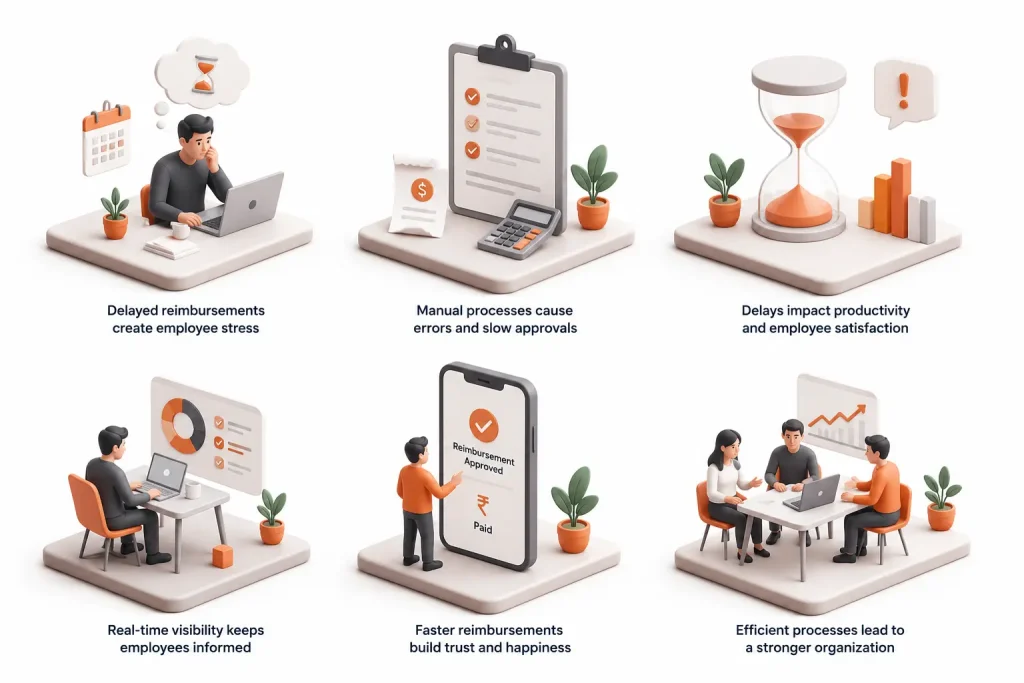
why an expense reporting platform improves employee experience

Why an Expense Reporting Platform Improves Employee Experience

An advanced expense reporting platform benefits both employees and finance departments.

Mobile Accessibility

Employees can submit expenses from anywhere, making reporting convenient during business travel.

Automated Receipt Management

Digital receipt capture eliminates paperwork and reduces missing documentation.

Faster Reimbursements

Automation shortens approval cycles, allowing employees to receive payments much sooner.

Better Reporting

Finance leaders gain access to dashboards showing:

  • Outstanding claims
  • Average reimbursement time
  • Department-wise expenses
  • Policy violations
  • Spending trends

These insights help improve financial planning while ensuring a better employee experience.

Best Practices for Reducing Expense Delays

Organizations looking to improve reimbursement processes should consider the following strategies.

Digitize Expense Reporting

Replace spreadsheets and paper forms with a centralized expense reporting platform.

Simplify Approval Processes

Reduce unnecessary approval layers while automating routing and reminders.

Define Clear Expense Policies

Employees should understand:

  • Eligible expenses
  • Spending limits
  • Receipt requirements
  • Submission deadlines

Clear policies reduce errors and speed up approvals.

Encourage Prompt Expense Submission

Employees should submit expenses immediately after travel rather than waiting until the end of the month.

This keeps financial records accurate and improves cash flow visibility.

Monitor Reimbursement Performance

Track key metrics such as:

  • Average reimbursement time
  • Pending claims
  • Approval turnaround
  • Policy compliance rate

Continuous monitoring helps identify process improvements.

Conclusion

Expense reimbursements are more than an administrative task—they directly influence employee satisfaction, trust, and productivity. When employees experience long reimbursement delays, they often feel frustrated, financially burdened, and less engaged at work.

By investing in modern travel and expense management software and implementing a reliable expense reporting platform, organizations can simplify expense reporting, automate approvals, improve financial visibility, and ensure employees are reimbursed quickly and accurately.

A faster, more transparent reimbursement process benefits everyone. Employees spend less time chasing payments, finance teams reduce administrative workloads, and businesses build a stronger culture of trust and accountability.

Frequently Asked Questions

Why do expense reimbursement delays affect employee satisfaction?

Delayed reimbursements create financial stress, reduce trust in the organization, and force employees to spend extra time following up on payments instead of focusing on their work.

What is travel and expense management?

Travel and expense management is the process of managing business travel bookings, expense claims, approvals, reimbursements, and policy compliance through a centralized system.

How does an expense reporting platform improve reimbursements?

An expense reporting platform automates expense submission, approval workflows, receipt management, and reimbursement tracking, significantly reducing processing times.

What causes reimbursement delays?

Common reasons include manual approvals, missing receipts, outdated reporting systems, multiple approval levels, and limited visibility into claim status.

How can businesses reduce expense processing time?

Businesses can reduce delays by digitizing expense reporting, automating approvals, implementing clear expense policies, and using real-time expense tracking tools.

Ready to Eliminate Expense Delays?

Don’t let slow reimbursements impact employee morale or create unnecessary administrative work. With ExpenseOut’s intelligent travel and expense management solution, your business can automate expense reporting, accelerate approvals, improve policy compliance, and provide employees with a seamless reimbursement experience.

Book a personalized demo today to see how ExpenseOut can help your organization simplify expense management, improve employee satisfaction, and give your finance team complete control over every business expense.


reducing employee burnout through better expense processes

Reducing Employee Burnout Through Better Expense Processes

Employee burnout isn’t always caused by long hours or demanding workloads. Sometimes, it’s the everyday administrative tasks that slowly wear employees down. One of the biggest yet often overlooked contributors is the expense reporting process.

After a business trip, employees often spend hours organizing receipts, filling out spreadsheets, following up on approvals, and waiting weeks for reimbursement. While these tasks may seem minor individually, they add up over time, creating frustration, reducing productivity, and impacting employee satisfaction.

Modern businesses are rethinking travel and expense management by investing in expense analytics software and expense reporting software. These solutions simplify expense reporting, automate reimbursements, improve receipt management, and provide valuable spending insights.

In this guide, we’ll explore how inefficient expense processes contribute to burnout, the common challenges organizations face, and practical ways to create a smoother expense management experience.

How Expense Management Contributes to Employee Burnout

Expense reporting affects employees across departments, especially those who travel frequently for client meetings, conferences, or business visits.

When the process is manual and time-consuming, employees often deal with:

  • Hours spent preparing expense reports
  • Lost or damaged receipts
  • Delayed reimbursements
  • Multiple approval follow-ups
  • Unclear expense policies
  • Repetitive data entry

Instead of focusing on meaningful work, employees spend valuable time completing administrative tasks. Over time, this leads to frustration, reduced engagement, and lower productivity.

Common Challenges in Travel and Expense Management

Many businesses still rely on outdated processes that create unnecessary workload for both employees and finance teams.

1. Manual Expense Reporting

Manual expense reports require employees to enter every transaction, attach receipts, and categorize expenses individually. This increases the chances of errors, duplicate entries, and missing information while slowing down approvals.

2. Delayed Expense Reimbursements

Employees often wait days or even weeks to receive reimbursement because of multiple approval stages, missing documents, or manual verification. Delayed payments can create financial stress, particularly for employees who travel frequently.

3. Receipt Management Issues

Receipt management remains one of the biggest pain points in expense management.

Common issues include:

  • Lost paper receipts
  • Faded receipts
  • Missing invoices
  • Duplicate submissions
  • Manual receipt verification
  • Difficulty storing records for audits

Poor receipt management increases processing time and creates additional work for finance teams.

4. Limited Visibility into Spending

Without centralized expense data, businesses struggle to understand:

  • Which departments spend the most
  • Where travel costs are increasing
  • Vendor spending patterns
  • Areas where expenses can be reduced

This lack of visibility makes cost control difficult.

5. Policy Compliance Challenges

Employees may unintentionally submit expenses that don’t comply with company policies due to unclear guidelines or inconsistent enforcement. This results in rejected claims, additional reviews, and reimbursement delays.

How Better Expense Processes Reduce Burnout

Improving expense management is about removing unnecessary friction from employees’ daily work.

Automate Expense Capture

Modern expense reporting software allows employees to capture receipts instantly using a mobile app. The software automatically extracts key information such as merchant name, amount, date, and tax details, eliminating manual data entry.

Simplify Expense Submission

Instead of filling out spreadsheets, employees can submit complete expense reports within minutes. Built-in policy checks help identify issues before submission, reducing corrections later.

Accelerate Approvals

Automated approval workflows send reports directly to the appropriate manager. Notifications and reminders help reduce delays, ensuring faster processing.

Speed Up Expense Reimbursements

Faster approvals mean quicker reimbursements, reducing financial stress and improving employee satisfaction. Employees spend less time tracking payment status and more time focusing on their work.

The Role of Expense Analytics Software

While automation improves efficiency, expense analytics software helps organizations make smarter financial decisions.

It provides real-time insights into spending trends, enabling finance teams to identify opportunities for savings and improve policy compliance.

Expense analytics helps businesses:

  • Monitor departmental spending
  • Identify policy violations
  • Detect duplicate claims
  • Track reimbursement timelines
  • Analyze travel expenses
  • Improve budgeting and forecasting

Instead of reacting to overspending, organizations can proactively control costs.

Best Practices for Smarter Expense Management

Businesses looking to reduce employee burnout should combine technology with better processes.

Create Clear Expense Policies

Employees should have easy access to simple, well-defined expense policies. Clear guidelines reduce confusion and minimize rejected claims.

Digitize Receipt Management

Replacing paper receipts with digital storage improves record keeping, simplifies audits, and reduces lost documentation.

Automate Approval Workflows

Automated routing eliminates manual follow-ups and ensures expense reports reach the right approver quickly.

Provide Real-Time Status Updates

Employees should be able to track the progress of their expense reports and reimbursements without contacting finance teams.

Integrate Travel and Expense Systems

Connecting travel booking with expense management eliminates duplicate data entry and improves reporting accuracy.

signs your business needs better expense reporting software

Signs Your Business Needs Better Expense Reporting Software

Your organization may benefit from modern expense reporting software if:

  • Employees frequently complain about reimbursement delays.
  • Expense reports are created using spreadsheets.
  • Lost receipts are common.
  • Finance teams spend excessive time reviewing reports.
  • Approvals require repeated follow-ups.
  • Audits take too long to complete.
  • Spending trends are difficult to analyze.

These challenges often indicate that manual processes are limiting efficiency and affecting employee experience.

Benefits Beyond Reducing Burnout

Modern expense management solutions create value across the organization.

For Employees

  • Less administrative work
  • Faster reimbursements
  • Better visibility into claim status
  • Reduced financial stress
  • Improved job satisfaction

For Finance Teams

  • Faster processing
  • Better compliance
  • Reduced manual effort
  • Improved reporting
  • Easier audits

For Business Leaders

  • Greater spending visibility
  • Better budget control
  • Data-driven decision making
  • Stronger financial governance
  • Improved operational efficiency

Frequently Asked Questions

What is expense analytics software?

Expense analytics software helps businesses analyze employee spending, monitor budgets, identify trends, and improve financial decision-making using expense data.

How does expense reporting software reduce employee burnout?

It automates expense submission, receipt capture, approvals, and reimbursements, reducing administrative work and saving employees valuable time.

What are the biggest challenges in travel and expense management?

The most common challenges include manual expense reporting, delayed reimbursements, receipt management issues, poor visibility into spending, and policy compliance problems.

Why is receipt management important?

Effective receipt management reduces errors, simplifies audits, speeds up reimbursements, and ensures expenses are properly documented.

How can businesses improve expense reimbursements?

By automating approval workflows, digitizing receipts, simplifying expense reporting, and implementing modern expense management software.

Conclusion

Employee burnout isn’t always caused by demanding projects. Often, it’s the repetitive administrative tasks that create unnecessary stress and reduce productivity. Manual expense reporting, delayed reimbursements, and inefficient receipt management can negatively impact both employees and finance teams.

By adopting modern expense analytics software and expense reporting software, businesses can streamline travel and expense management, automate routine tasks, improve visibility into spending, and deliver faster reimbursements. The result is a more efficient finance process and a better employee experience.

Ready to Transform Your Expense Management?

If your organization is still relying on spreadsheets, paper receipts, or slow approval workflows, now is the time to modernize. ExpenseOut helps businesses automate expense reporting, simplify receipt management, accelerate reimbursements, and gain actionable insights through advanced expense analytics.

Book a demo today and discover how smarter expense management can reduce employee burnout while improving productivity and financial control.

The Startup Founder’s Guide to Expense Control

The Startup Founder’s Guide to Expense Control

Introduction

A startup’s biggest financial challenge isn’t always generating revenue—it’s knowing where the money is going.

Many founders closely track payroll, funding, and customer acquisition costs but overlook day-to-day expenses. Business travel, software subscriptions, employee reimbursements, and operational spending can quietly increase month after month, pushing burn rates higher than expected.

The problem usually isn’t overspending. It’s a lack of visibility.

This guide explores common expense challenges startups face and practical ways to maintain control as your business grows.

Why Expense Control Gets Harder as You Scale

Managing expenses is simple when a startup has a handful of employees. Everyone knows who spent what, and approvals happen quickly.

As teams grow, spending becomes decentralized. Sales teams travel more, departments purchase their own tools, and reimbursement requests increase. Without proper processes, founders can lose sight of where company money is being spent.

Small inefficiencies may seem harmless, but they add up quickly and can affect cash flow, budgeting, and runway.

Common Expense Problems Startup Founders Face

Rising Travel Costs

Travel is often one of the first expenses to grow as startups expand.

Sales meetings, client visits, conferences, and investor meetings can lead to inconsistent spending patterns. Employees may book different airlines, hotels, or transportation options, making costs difficult to track.

Without visibility, travel expenses can exceed budgets before anyone notices.

This is why many growing companies use travel expense automation to simplify reporting and gain better oversight of travel-related spending.

Subscription Sprawl

Most startups accumulate software subscriptions over time.

Different teams adopt tools independently, free trials turn into paid plans, and unused licenses remain active long after they’re needed.

A quarterly review of software expenses often reveals opportunities to reduce unnecessary spending without affecting productivity.

Slow Reimbursements

Manual reimbursement processes create frustration for both employees and finance teams.

Missing receipts, delayed approvals, and email-based workflows can turn a simple reimbursement into a lengthy process.

The longer reimbursements take, the more administrative work is created for everyone involved.

Why Spreadsheets Eventually Become a Problem

Spreadsheets work well in the early stages of a startup.

However, as transaction volumes increase, manual tracking becomes harder to maintain.

Common challenges include:

  • Data entry errors
  • Missing expense records
  • Delayed reporting
  • Multiple spreadsheet versions
  • Limited visibility into real-time spending

When founders can only review expenses after they occur, controlling costs becomes much more difficult.

What Effective Expense Control Looks Like

Expense control isn’t about restricting spending. It’s about making informed decisions.

Create Clear Policies

Employees should know:

  • Which expenses are reimbursable
  • Spending limits
  • Approval requirements
  • Receipt submission expectations

Clear guidelines reduce confusion and improve compliance.

Give Departments Budget Ownership

Department leaders should understand their budgets and be accountable for spending decisions.

This creates greater financial awareness throughout the organization.

Focus on Trends, Not Individual Expenses

Rather than reviewing every transaction, look for patterns.

Ask questions such as:

  • Which departments spend the most?
  • What expenses are increasing?
  • Are travel costs staying within budget?
  • Which subscriptions are underutilized?

Trend analysis often reveals the biggest opportunities for improvement.

How Technology Helps Growing Startups

As startups scale, manual expense management becomes increasingly difficult.

Modern corporate expense software helps businesses:

  • Capture receipts digitally
  • Automate approval workflows
  • Improve expense visibility
  • Track spending in real time
  • Generate accurate reports

Similarly, travel expense automation helps businesses manage travel-related costs more efficiently by reducing manual reporting and improving compliance.

The value isn’t simply automation. It’s having access to accurate financial information when decisions need to be made.

expense categories founders should monitor closely

Expense Categories Founders Should Monitor Closely

Employee Travel

Track:

  • Flights
  • Hotels
  • Transportation
  • Meals
  • Client entertainment

Software and Technology

Review:

  • Active subscriptions
  • License usage
  • Vendor contracts
  • Renewal schedules

Marketing Spend

Monitor:

  • Advertising campaigns
  • Events
  • Sponsorships
  • Agency costs

Operational Expenses

Evaluate:

  • Equipment purchases
  • Office expenses
  • Communication tools
  • Remote work allowances

Regular reviews help identify unnecessary costs before they become significant.

Questions Every Founder Should Ask Monthly

A simple monthly review can reveal spending issues early.

Consider asking:

  • Where did we spend more than expected?
  • Which costs increased this month?
  • Are departments staying within budget?
  • How much are we spending on travel?
  • Are reimbursements being processed efficiently?
  • Are there subscriptions we no longer need?

Consistent reviews help maintain financial discipline without slowing growth.

Conclusion

Most startups don’t struggle because of one major expense. They struggle because small spending leaks go unnoticed over time.

Effective expense control is about visibility, accountability, and better decision-making. By establishing clear policies, monitoring spending trends, and improving expense processes, founders can gain greater control over cash flow and support sustainable growth.

As your startup grows, understanding where every dollar goes becomes just as important as generating the next dollar of revenue.

FAQs

Why is expense control important for startups?

It helps improve cash flow management, extend runway, and prevent unnecessary spending.

What is corporate expense software?

Corporate expense software helps businesses manage expenses, approvals, reimbursements, and reporting through a centralized system.

How does travel expense automation help startups?

It simplifies travel expense reporting, improves visibility, and helps businesses monitor travel-related spending more effectively.

What are the most commonly overlooked startup expenses?

Software subscriptions, travel costs, employee reimbursements, and recurring operational expenses are often overlooked.

How often should startups review expenses?

Most startups benefit from monthly reviews and quarterly assessments of spending trends and budgets.

Take Control of Your Startup Expenses Before They Control Your Growth

As startups scale, managing expenses becomes increasingly complex. What starts as a few reimbursements and software subscriptions can quickly grow into a web of travel costs, recurring payments, approval bottlenecks, and limited spending visibility.

The key is to build strong expense management habits early. By creating clear policies, monitoring spending regularly, and streamlining expense processes, founders can make more informed financial decisions and avoid costly surprises down the road.

If your team is spending too much time managing receipts, approvals, and reimbursements, it may be time to rethink your expense management process. The right systems can help you gain better visibility into company spending, improve efficiency, and focus more of your energy on growing the business.

Looking for a smarter way to manage business expenses and travel spend? Explore how modern expense management solutions can help your startup stay organized, compliant, and financially in control as it scales.

Airline Passengers with Dashboard - Banner Image For ExpenseOut Blog

6 Ways to Slash Your Business Travel Expenses

Business travel is an absolute necessity to set up or expand a business.

But with the rising fuel prices and pent-up travel demand, companies must have control over their travel expenses with well-defined practices and policies that optimize the way employees’ book for business travel. 

Making corporate travel savings might sound like a challenge – especially if you have more employees flying to different destinations.

However, with the right technology and management strategies, the business can simplify, systemize, and save on their business travel expenses.

Below are six ways to keep costs down without compromising employee safety or services.

Set proactive travel policy

When setting out a corporate travel policy, there are many things to consider, from booking flights to meal allowances. 

Take a closer look at your existing corporate travel policy and think about whether it is robust enough to cover your company’s entire area of travel spending.

An effective travel policy should provide clear information to your employees. It should include a proper approval process and guidelines on bookings and reservations. Setting out clear procedures helps your employees to make decisions that stay within your policy.

Combat expense report fraud 

Sometimes employees will take advantage of your reimbursement process, claiming expenses that are not in alignment with corporate travel policy.

Expense reimbursement fraud is easy to catch and prevent, especially with an automated system that can detect phony receipts, expenses that have been claimed repeatedly, and transactions that aren’t policy compliant.

Bringing down expense report fraud— and eliminating the countless hours it takes to identify it— by leveraging automation, can go a long way in reducing the resources it takes to handle your business travel needs.

Save money on flights

Airlines can be expensive, especially if your employees fly frequently. You could save money by booking tickets at least one month before the travel date. If you choose economy flights, you can save hundreds of dollars per trip. Also, getting alerts for airfare promotions and discounts reduces your business travel costs. 

Have a pre-trip approval process

One of the simplest ways to reduce your business travel spends is by implementing an approval system for every booking. Assign approvers at multiple levels and ensure that every aspect of the trip is in alignment with company policy. Doing so will help avoid post-booking cancellations and save costs.

Make use of discounts and reward programs

Most airlines/hotels/car rental companies offer discounts and reward programs to build customer loyalty. Make sure your finance department keeps track of bonus miles, discounts, and other special offers and uses them to reduce costs when possible.

Reward your employees

Every time your traveller picks the most cost-effective option, they save the company money. Motivate them by giving gifts, vouchers, or extra time off. Use these ways to thank employees for reducing your travel costs and encourage them to keep doing it.

Conclusion

Manual expense reporting consumes more of your business hours. So, investing in a Travel and expense management solution can save time. A solution like ExpenseOut not just simplifies the whole T&E process, but it also comes with features, like expense reporting, automated approval, and policy compliance that make the finance team, management, and employees more productive.

With ExpenseOut, you can save up to 20% of your annual travel costs. 

Want to know how automated travel and expense management can cut down costs? Schedule a demo with us today to check how much your organization can save.

Why-does-your-startup-need-an-expense-management-solution-768x400

The definitive guide to managing petty cash advance in 2022

Cash advances have become one of the most common ways for employers to fund the business travel operations of their employees, including utilities, local transport, and daily meals. However, managing cash advances has turned out to be a massive problem for the accounting team due to the multiple business meetings, travel spending needs, and projects that companies have going on simultaneously. 

Here’s what’s causing the accounting woes for companies and how to fix them. 

The present scenario–a broken cash management system

Traditional means of managing cash advances have failed and consequently caused the following hurdles to the audit readiness of organizations. 

  • Violation of crucial Travel and Expense (T&E) policies while processing urgent request
  • Delays and errors during the reimbursement process due to manual processing of cash advances
  • Large scale, unchecked expense fraud 
  • Poor employee experience due to the tedious nature of acquiring cash advances 
  • Inability to make exceptions for cash advances in urgent situations

What causes friction in the process of getting cash advances for business travel?

Most organizations have a manual process for handling cash advances, and this opens the process to all the following issues that affect every level of the company. 

  • Employees must fill out tiring forms or send emails constantly for cash advances.
  • The manager must sift through countless emails and/or paper forms to check and grant the request. 
  • Exceptions can’t be processed quickly as managers have to manually reach out to higherups for approvals.
  • There’s no transparency, so employees have no idea about the status of their cash advance request.
  • Lack of transparency about non reimbursable expenses
  • Discrepancies arise in the expense reports 

The ultimate fix for petty cash management hurdles—automation

Automation of the entire process of petty cash management has untold benefits in terms of time saved and fraud prevented. With the right solution, both the employer and the employees can breathe easy because their life has been made better in the following aspects:

  • Every expense receipt is accounted for
  • Enhanced transparency when it comes to the status of the payment request 
  • Automated policy compliance for all expenses
  • Seamless payment collection
  • Easy to process urgent requests
  • Companies can prepare quickly for audits
  • Hassle-free and quick reimbursements for employees
  • Weeds out duplicate or fraudulent requests
  • Repetitive approval workflows are automated

ExpenseOut’s unparalleled petty cash advance management capabilities

Managing petty cash for business travel may seem like a trivial matter that you can manage with a few forms or spreadsheets or an email thread.

 However, when you consider the hours you spend tracking, reporting, reimbursing, and accounting for every single cash advance request, you will see how an automated solution like ExpenseOut can do wonders for you.

Here’s an overview of how ExpenseOut approaches the cash advance process that is key to every company’s financial health. 

  • The employees raise a cash advance request via the ExpenseOut web portal or app.
  • The request is automatically checked against the T&E policy of the company
  • The manager or admin gets a real-time notification of the request
  • The manager/ admin approves the request, and the money gets credited
  • If the cash advance is unused, the system automatically initiates a refund

Conclusion

Sounds fascinating? Your company can also save countless hours of time and innumerable resources by automating petty cash management. If you want a preview of what ExpenseOut can do for you, feel free to reach [email protected] for a demo/ quote.

Expense-Reimbursements-Are-Hurting-Your-Employees-and-Your-Business-59-scaled

Expense Reimbursements Are Hurting Your Employees and Your Business

According to the Association of Certified Fraud Examiners, expense reimbursements  are responsible for 21% of fraud at small businesses and 11% at large businesses. But that’s not the least of the worries a company faces when reimbursing employees for travel and expenses (T&E). Approving expense reports is a manual and tedious process that ties up the finance team and managers for hours. 

Add to it the inconvenience caused to employees who have to wait for weeks or months for their expense reports to get approved, and you have a good idea why the conventional expense reimbursement process is a mess.

If you are not yet convinced, read on to know all the reasons why your company needs to make a radical change in the way it reimburses employees.  

How reimbursements are a pain for the company

Policy violation

In a shocking study, it was found that nearly two-thirds of employees haven’t read their company’s spending policy. Even more worryingly, 85% of employees admit to lying on their expense reports. 

The present method of employees submitting old paper receipts or filling up spreadsheets with virtually no supervision is in no way equipped to handle the dual challenges of fraud and policy violations borne out of ignorance. This weakness of conventional reimbursement methods is prevalent because finance teams must manually process hundreds or even thousands of expense reports from different employees who may have entirely different spending policies. 

Also, since paper receipts are involved, there is no way to check them for authenticity or ensure the same receipts aren’t submitted multiple times or by different people. 

Processing costs and time

Studies indicate that an average expense claim takes about 20 minutes to process. Considering that hundreds of expense reports go through the system every year, wasting the time of everyone involved, it is sensible to assume that the process drains valuable time from the company. 

Due to all the waste of time and resources, it is estimated that an expense claim costs $58 to process, which is a hefty sum.

As per the same report, there is a worrying trend of errors in the expense claims processing stage. Notably, the same report claims that 19% of expense reports contain errors and that correcting an expense report takes about 18 mins and costs about $52. 

How reimbursements are a pain for your employees

Delays in reimbursements

Because of complications in the process and unclear rules, 48% or so of employees are still using their own money for company expenses without being reimbursed. Given how on-field employees spend a lot of money (10 to 15% of their salary) for travel and other related expenses, failure to reimburse or delays in the process can be quite demoralizing.  

When employees have to wait for long to get reimbursed, it creates an atmosphere of distrust and resentment, which only worsens if they repeatedly need to confront the management or finance department to process their reimbursements. 

Hassles in the reporting process

For the most part, employees have to carry around crumbling paper receipts or fill-out extensive spreadsheets if they want to file an expense. While filling out the form or submitting their receipts, they have no way of knowing whether their submission followed company policy. 

Consequently, when the reimbursement doesn’t come or is delayed, employees are left wondering why they had to go through all that trouble. Add to this inconvenience the wasted hours of the employee, and you have the recipe for a crisis in the form of high levels of employee dissatisfaction and turnover.  

Conclusion

Expense management is undoubtedly a painful process for both the company and the employee. For the company, it is wasted hours and money down the drain. For the employee, manual expense reporting represents a financial burden, lost productivity, and delays in getting their money back. 

As a result, automated expense management is the way to go. Apart from bringing much-needed efficiency to the process, it also substantially boosts visibility and improves policy compliance.

Implications of hike in service tax on business travelers

Implications of hike in service tax on business travelers

Implications of hike in service tax on business travelers

The service tax for business travel, which went from 12.36% to 14%, has been a topic of heated discussion in corporate circles. This is because the hike in service tax will raise the price of flights, cabs, hotels, and food, which are all unavoidable when it comes to business travel.

How rising services taxes will take a toll on your company’s balance sheet

Here is an easy-to-understand representation of the extent to which your company will get affected. Imagine you spend 10 Lakhs/ 13,613.78 United States Dollar on yearly business travel.  The following table lays out what the impact on your expenses will be under the new tax regime.

Financial Year  2014 – 152015 – 16
CategoriesSpending %AmountService Tax (12.36%)Service Tax (14%)
Air(Economy class)24.4924490012107.85613714.4
Air(Business class)15.51550007663.213020
Rail11.51150004264.24830
Hotel(Premium with food)25.5925590022140.4685078.2
Hotel(Guest house, residential)12.061206008943.63610130.4
Car7.57500037084200
Others3.36336001661.1841881.6
Total100100000060488.60472854.6
Total spending includes service tax (In INR)1060488.6041072854.6
Increase in travel spending per year (In INR)12365.996 

From the table, you can see how a rise in the service tax will affect airfare for business class flights. Moreover, increases in hotel prices will set your company back by thousands of dollars in the long run if left unmanaged.

This means that managing T&E is the biggest challenge facing companies across the world.

What can be done about the rising T&E?

Here are a few things to do to mitigate the effect of the rise in service tax. The following steps will help you bring down your T&E greatly.

  • Automate your expense reporting to save your employee’s time.
  • Automate expense tracking to cut down on the time and money wasted to manually track each expense.
  • Ensure better policy compliance in expense reporting.
  • Make every employee aware of the budget limitations and the company policy on spending so that money is not wasted.
  • Ensure quicker approval, booking, and reimbursement for air travel and business trips.

Conclusion

Want to reduce the burden of increased service tax? You can opt for a web-based expense management solution that will save money for you when it comes to business travel expenses.

For this purpose, we have created ExpenseOut, with its myriad inbuilt customized features that allow you to make expense management an easy and happy process.